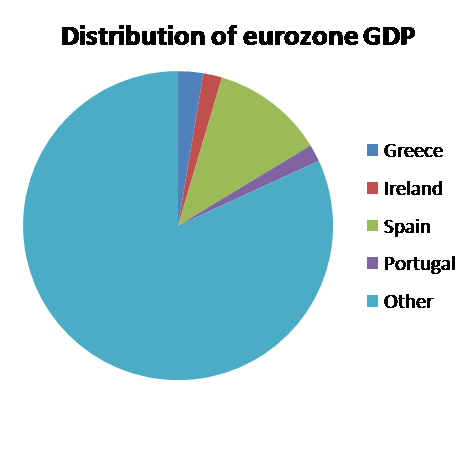
Not a big problem, right? Unfortunately, Krugman's chart ignores the power (and weakness) of leverage. That's where we should start. If you want to compare Greece to the Eurozone – or anywhere else, for that matter – look at the size and composition of its debt. But more on that in a minute.
More importantly, Krugman's data don't capture this bit of news: Greek finance authorities have significantly understated the magnitude of their deficits. That is, to get around European regulation limiting deficits, Greece, with the help of Goldman Sachs brokers, traded in swap contracts that actually makes its deficits much worse.
From Felix Salmon:
Greece has been hiding the true nature of its deficits and its debt using clever derivatives dreamed up by Goldman Sachs.Why is this important? Remember, Krugman's pie chart tells us that Greece's economic output is only a tiny fraction of the overall economic output of all of Europe. Things are bad for the Eurozone, he says, but not that bad.
[…]
It's a bit depressing that EU member states are behaving in this silly way, refusing to come clean on their real finances.
Well, in a world like ours, people, companies, and yes, countries, can borrow above and beyond their economic output. Think of it this way: AIG's Financial Products division – a tiny office in a giant company – insured more than $441 billion worth of clever derivatives (credit default swaps) before things took a turn for the worse. Did AIG have the almost half-trillion dollars on hand to payout on those derivatives? Not even close.
But here's the thing about AIG, which explains why the Greece deficit story is problematic: we have to understand that a giant insurance company didn't bring the U.S. financial system to its knees. A tiny office in a giant company did. Or to put it another way, AIG's Financial Products division had far too much leverage, which AIG couldn't sustain.
Greece, like that tiny office in AIG, is considerably levered up. And now we find out that the country has been misrepresenting the extent of that leverage! My perspective is a bit different; indeed, Europeans should be heading for the hills.


While this is quite obviously ad hominem...I don't for the life of me understand why you look at Krugman as an interesting (let alone honest) economist. His entire method is make his economic argument fit his political one by ignoring inconvenient data.
ReplyDeleteI'm not trying to address his claims here...I'm just amazed you even bother to read him. It's like reading Ann Coulter for legal analysis. [In case you weren't aware, she was a pretty bright lawyer].
To each his own, I guess. I'm just not a masochist. :)
I look at Krugman because he is the most influential American economist alive. He has the ear of every policy maker in government. And in order to understand the debate and the motivation of the players, you have to go to the intellectual source. Krugman is it right now.
ReplyDeleteIn terms of turning ideas into actionable items -- bridging academia and politics -- there is no one better than Krugman. His intellectual fingerprint can be found on a bevy of Obama's key proposals. Large Keynesian stimulus? Krugman. Jobs summit? Krugman. Medicare for All? Krugman.
By the way, I agree with almost nothing he says.
But here's the thing that makes him so influential: Krugman's a master at moving the goalpost. That is, when making his case, he makes broad generalizations that mostly miss their mark, marshals only the relevant data, and misprepresents the ideas of the opposition.
For a guy who is regarded with such high esteem in the economic sciences, he is the furthest thing from a scientist, wouldn't you say?
I disagree with both of you.
ReplyDeleteFirst, VM, Krugman's intellectual fingerprint isn't all over Obama's key proposals. In fact, if you regularly read Krugman, you'll detect a recurring note of disappointment (which began during the primaries, of course). Krugman wanted a much bigger stimulus (and now a second one), as well as a plan to nationalize the banks (ignored) and a single-payer health system (also ignored).
Second, I find it interesting that other right-wing economists who make clearly ideological points -- Friedman, for instance -- are held up as scientific paragons, but Krugman criticized for doing the same thing.
Everyone's a politician, folks.
He has the ear of Democratic policy makers perhaps. It isn't clear to me that any conservatives really take him seriously. I've gathered a lot of them only even talk about him because he has a column in the Times.
ReplyDeleteAs for Berchman's points...
Krugman now claims he asked for a larger stimulus. But if you actaully read what he wrote/said at the time, you find out that he's just making stuff up.
See his blog here: http://krugman.blogs.nytimes.com/2008/11/10/stimulus-math-wonkish/
The actual stimulus was $787 billion, give or take. Krugman was calling for a stimulus of at least 4% GDP, or $600 billion, and criticizing Pres. Obama for allegedly thinking smaller. One might argue that a bigger stimulus was actually needed than $787 billion (though I don't think so), but Krugman's assertion that he knew all along that the stimulus was too small to work is wholesale fabrication. Why he's allowed to pretend otherwise I don't understand.
As for Krugman's support of a single-payer health care system. It illustrates to me his big flaw: he rails on Democratic boilerplate on subjects outside of economics, and we're all supposed to treat him like he has some font of wisdom on the given subject. I'm fine with him commenting on stuff outside economics, but 1)he acts like he's an expert, and 2)he very option misrepresents facts on those things as well.
As for comparisons to Friedman, et al. I've seen plenty of instances where Krugman willfully distorts or ignores facts when drawing his conclusions. I've never heard of Friedman and Co. doing so, though if someone can find instances perhaps I'll change my view. My understanding is that they ran numbers and when the time came to make subjective conclusions off of them, they tended towards conservativism. Many might disagree with those eventual conclusions, but they were based on a foundation of legitimate numbers. (In part they had to be since they started out at such an outsider status that Keynesian nitpicked their conclusions to death).
Krugman makes subjective conclusions and then twists economic numbers to meet those conclusions. Or at least that's my impression.
Btw...Krugman also was adament that we'd see the fruits of the stimulus already in his earlier writing. But now he claims that he's always said it would take longer.
ReplyDeleteBasically, I find the changing goalposts that VM mentioned to be aggravating. It's impossible to argue with a moving target.
Actually, Krugman hasn't changed his tune on the stimulus' size. The blog you cited was written late 2008, but as the depth of the recession became clearer -- and the forecasts grew worse -- he argued for a larger stimulus.
ReplyDeleteSo, in Jan. 8, 2009, just a few months later, he wrote:
[Even the C.B.O. says, however, that “economic output over the next two years will average 6.8 percent below its potential.” This translates into $2.1 trillion of lost production. “Our economy could fall $1 trillion short of its full capacity,” declared Mr. Obama on Thursday. Well, he was actually understating things.
To close a gap of more than $2 trillion — possibly a lot more, if the budget office projections turn out to be too optimistic — Mr. Obama offers a $775 billion plan. And that’s not enough.]
I don't think that's necessarily "changing the goalposts." New facts led to new opinions.
As for examples of Krugman willfully ignoring facts, please send them to me.
I hadn't seen that later quote, so I give him credit for updating his opinion earlier than I had thought he did. In that sense, I was wrong to think he had maintained his prior position until recently.
ReplyDeleteAnd of course I have no problem with new facts leading to new opinions (it would be idiotic not to).
I will suggest that when you read Krugman on the stimulus, he seems to imply that he was convinced from day one that the stimulus was too small. That simply wasn't so.
As for Krugman willfully ignoring facts...Rather than my scouring the internet for them, I would merely note that if you do a net search for "Krugman lies" or some varient, you'll find whole websites dedicated to Krugman distortions.
I may be too strong in suggesting that he literally alters numbers. But I think it's indisputable that he routinely alters his claims based on what have to be political calculations. For an example, see this article from Tuesday on the Investors Business Daily website:
http://blogs.investors.com/capitalhill/index.php/home/35-politics/1372-paul-krugmans-breathtaking-hypocrisy
Out of curiousity, Berchmans:
ReplyDeleteYou made the comment earlier that "Everyone is a politician." Does that imply that you agree Krugman (ostensibly like everyone else) isn't an objective purveyor of information?