Wednesday, September 30, 2009

What Multiplier Effect?

Robert Barro and Charles Redlick say that the Keynesians have it all wrong. Fiscal stimulus does not work; even in times of crisis, an increase in government spending does not increase GDP by the same amount. In fact, the authors say, there is evidence that tax cuts often work better than fiscal stimulus.
The existing empirical evidence on the response of real gross domestic product to added government spending and tax changes is thin. In ongoing research, we use long-term U.S. macroeconomic data to contribute to the evidence. The results mostly favor tax rate reductions over increases in government spending as a means to increase GDP.

Sunday, September 27, 2009

More on Universal Health Care

John F. Cogan, R. Glenn Hubbard and Daniel Kessler try to debunk two of President Obama's most compelling -- and oft-repeated -- claims about a universal health insurance plan. Namely, Obama's plan claims that it will benefit everyone who already has health insurance and will not add to the burgeoning federal deficit.
The mandates will lead to large increases in the cost of health insurance for everyone. Research studies have shown that as people become insured, especially under a health plan that offers broad coverage and low copayments, they consume more health-care services. The best estimates indicate that each newly insured person will approximately double his or her health spending. ...

The entitlement-based subsidy, combined with the proposed Medicaid expansion, would add between $700 billon and $1.2 trillion to federal spending over the next decade, according to the Congressional Budget Office. The new entitlements would come on top of existing federal health-care entitlements that the government has been neither able to control nor finance.

Who Says the Individual Health Care Mandate is a Tax?

Are mandated health benefits also a tax? President Obama says no.
[F]or us to say that you've got to take a responsibility to get health insurance is absolutely not a tax increase. What it's saying is, is that we're not going to have other people carrying your burdens for you anymore than the fact that right now everybody in America, just about, has to get auto insurance. Nobody considers that a tax increase. People say to themselves, that is a fair way to make sure that if you hit my car, that I'm not covering all the costs. ...

[Y]ou can't just make up that language and decide that that's called a tax increase. ...

My critics say everything is a tax increase.
However, Larry Summers, Director of the National Economic Council, says that a mandate is a tax.
Judgments about specific policy proposals must depend on the particulars, but I find that there are important differences in the efficiency and distributional consequences of standard public provision and mandated benefit programs. Essentially, mandated benefits are like public progams financed by benefit taxes. This make them more efficient but less equitable than standard public programs.
Michael F. Cannon of the Cato Institute also says that an individual health mandate is a tax. He digs a little deeper and finds others who agree with him. Many of his sources currently serve for the Obama adminstration.

Cannon concludes by asking the following questions: "if an individual mandate is not a tax, why exempt anybody? If an employer mandate isn’t a tax, why exempt small businesses?"

Links for Sunday, Septmeber 27th

1. Is your bank underwater?

2. From the Austrian School to the Saltwater perspective: 100 best blogs for the economics student.

3. Did regulation cause the financial crisis?

4. Or is banker's pay to blame?

5. How far are you from a Big Mac? (linked to via Marginal Revolution.)

Update: Banker's pay is certainly not to blame, says this other essay.

Friday, September 25, 2009

Qaddafi's Rambling Speech at the U.N.

Some of the more delicious portions of Col. Muammar al-Qaddafi's speech to the U.N. General Assembly contain the following:
He also suggested that those who caused “mass murder” in Iraq be tried; defended the right of the Taliban to establish an Islamic emirate; wondered whether swine flu was cooked up in a laboratory as a weapon; and demanded a thorough investigation of the assassinations of John F. Kennedy and Martin Luther King... .

And he repeated his longstanding proposal that Israel and the Palestinian territories be combined into one state called Isratine.
Update: A reader over at Paul Krugman's blog , commenting on another rambling speech, says the following:
Why, back in the day, the norm for speeches in the Russian Politburo was 5-6 hours. No wonder Communism fell.


Iran's second nuclear facility...

We've all heard, I assume, that the cat's out of the bag about Iran's second nuclear facility (Iran announced it to the IAEA after becoming aware that the it was no longer secret, with the US having known about it for a year).

Beyond all the other discussion of it, I thought this tidbit from NBC's First Read was interesting:

*** We’ve known about this for a year: Per NBC’s Andrea Mitchell, officials say it was U.S. intelligence that learned of the secret plant more than a year ago -- before President Obama's election; Israel also knew about it, too. They most likely would not have gone public if Iran had not discovered that the U.S. was onto them and had it not notified the U.N.'s international inspection agency on Monday. By the way, Mitchell adds, the site is 30 kilometers outside of Qum, Iran’s holy city. That means that any military strike would be very difficult politically, because it would around[sic] huge reaction throughout the Muslim world. Also today, watch for Russian and Chinese reaction. Yes, they were notified of our intelligence this week, but their reaction is unknown.

From my perspective, if it becomes necessary to use military strikes to eliminate the Iranian threat (which I think it will be), I don't think it's even a question that the threat outweighs the risk of inflaming Muslim animus (as if we haven't already).

And of course, if Iran really cared about the sanctity of Qum, they wouldn't have placed an obvious military target right next door. In a rational world, the responsibility for any damage to Qum would fall on the party that uses it as a shield.

On the other hand, they may assume a lack of will on the part of the West to risk an attack, and consider it likely that its location is a protection. On this point, their perspective is pretty understandable if recent examples of Western resolve are considered.

E's Quote of the Day

"How, before the eyes of the world, could we justify meeting without tackling them?" Sarkozy scolded Thursday, referring to Iran and North Korea. "We live in the real world, not a virtual world. And the real world expects us to take decisions."
-- French Prime Minister Nicholas Sarkozy, on the omission of Iran and North Korea from the language of yesterday's anti-Proliferation resolution by the UN Security Council.

Thursday, September 24, 2009

New blog on the blog-roll

I came across a new blog called Secular Right, which I found was interesting. With a special affinity for David Hume, the blog mission states:

We believe that conservative principles and policies need not be grounded in a specific set of supernatural claims. Rather, conservatism serves the ends of “Human Flourishing,” what the Greeks termed Eudaimonia. Secular conservatism takes the empirical world for what it is, and accepts that the making of it the best that it can be is only possible through our faculties of reason.

Contributors: John Derbyshire, Andrew Stuttaford, Heather Mac Donald, Razib Khan, and Walter Olson.

You can find it on the blog-roll, or by clicking here.

_______________________________________________________________

Btw, I also added Michael Yon's website to the blog-roll list. The site is an essential read to gain insights into the wars in Afghanistan and Iraq. Yon has been imbedded in with Allied troops longer than any other reporter.

"Barack Hussein Obama!"

What indoctrination?. (via Drudge)

Are there limits in modern (bipartisan) presidential rhetoric? Not recently....

Rich Lowry, editor of National Review, posted this quick though in the Corner on Presidential rhetoric:

The Urge for Sweeping Generalizations Exists in Every Human Heart [Rich Lowry]


Now, having spent some more time with the Obama speech, I'm not any less appalled than I was at first blush. But it has one striking resemblance to a Bush speech — its unwarranted, overly optimistic generalizations about what people want. With Bush, everyone in the world was, just a little bit beneath the surface, a freedom-loving democrat. With Obama, everyone is a peace-loving multilateralist. "The yearning for peace is universal," Obama said. Of course, so is the yearning for war, or it wouldn't be endemic to human existence. Speeches like this are always going to be aspirational, but is it really too much to ask that U.S. presidents be a little more modulated, sociologically humble, and realistic?

Wednesday, September 23, 2009

Perhaps we should rename V-J day to "RETW-J" day...

In President Obama's speech, he includes this summary of US activity in Iraq:

In Iraq, we are responsibly ending a war. We have removed American combat brigades from Iraqi cities, and set a deadline of next August to remove all our combat brigades from Iraqi territory. And I have made clear that we will help Iraqis transition to full responsibility for their future, and keep our commitment to remove all American troops by the end of 2011. (emphasis mine)

In his last major speech outling his vision of Iraq, he also never once used the term "victory." Is he allergic to the idea? We WON the war in Iraq. AMERICA WAS VICTORIOUS.

Iraqis may not be able to maintain the system we gave them, but it is inarguable that Iraq has resulted in a military victory for US forces in Iraq, by any reasonable definition. Why the commander of those brave troops continues to be unable to acknowledge that fact is maddening.

Nial Gardiner is not a fan of President Obama's speech to the UN.

He refers to it as a candidate among the most naive speeches he's given.

Brett D. Schaefer, of the Heritage Foundation uses similar language: "Staggering naivete". (via the Corner)

You can find the text of Pres. Obama's speech here. I haven't had the chance to go through it yet, but from the snippets I've seen, it's a poorly thought out speech..

(I see Amb. John Bolton referred to as "the first post-American speech by the first Post-American president.")

Sunday, September 20, 2009

Links for Sunday, September 20th

1. Another provacative cover of the Economist.

2. Chris Dodd wants to merge all four bank regulatory agencies into one "super-regulator" (via CalculatedRisk).

3. President Obama refuses to halt the CIA probe into allegations of abuse of suspects (answering questions on the probe [time 9'00"]).

4. George Will on the futility of "nation building".

5. Obama is well-liked overseas, but does he get what he wants?

6. On love.

The Philosophy of Universal Health Care

Greg Mankiw's piece in yesterday's New York Times poses a tough question concerning universal health care. To wit, how does a society decide who's to receive the benefits of a limited resource? Or to put it another way, for someone who needs an extra bit of an expensive life-prolonging treatment, what's the mechanism by which we're to say, enough is enough?

It's a tough question, to be sure. Here's an excerpt:
The push for universal coverage is based on the appealing premise that everyone should have access to the best health care possible whenever they need it. That soft-hearted aspiration, however, runs into the hardheaded reality that state-of-the-art health care is increasingly expensive. At some point, someone in the system has to say there are some things we will not pay for. The big question is, who? The government? Insurance companies? Or consumers themselves? And should the answer necessarily be the same for everyone?

Update: The following link mirrors the argument Mankiw makes about technology comprising the biggest cost factor in U.S. health care. Bloomberg features this comparative analysis between the Canadian and U.S. health care systems and says that a portion in the differences in cost -- much lower in Canada -- can be attributed to the use of technology. Read on:
Technology partly explains the cost discrepancy between the two nations. There are 67 percent more coronary-bypass procedures in the U.S. than in Canada and 18 percent more Caesarean sections, OECD data show. In 2006, the U.S. had more than four times the number of magnetic resonance imaging units - - 26.5 for every million residents compared with 6.2 for every million in Canada -- making Americans three times more likely than Canadians to get a scan, according to the OECD. ...

“The real difference has been their ability to control technology costs,” said Anderson, who directed reviews of health systems for the World Bank and developed U.S. Medicare payment guidelines for the Health and Human Services Department. “The only thing the U.S. is consistently No. 1 in when it comes to international comparisons with Canada and other OECD countries is cost.”

Less technology and, according to a 2007 report from the World Health Organization, 20 percent fewer doctors in Canada than in the U.S. have led to longer lines north of the border. In 2008, 20 percent of chronically ill Canadians surveyed by the Commonwealth Fund reported waiting three months or more to see a specialist. Five percent of Americans polled said they had to wait that long.

Saturday, September 19, 2009

Charles Crawford on the Missile Shield

Here's an excellent summary and analysis of the decision by the Obama administration to cancel the "third site" missile system in Eastern Europe. It does, I think, an excellent job of being balanced in its analysis.

You can find it here.

Re: Missile Defense In Europe Scrapped

Haven't yet read enough to make any conclusions on the missile defense yet, but I think the Administration hasn't abandoned Poland or East Europe completely. From the Wall Street Journal:
Current and former U.S. officials briefed on the assessment's findings said the administration was expected to leave open the option of restarting the Polish and Czech system if Iran makes advances in its long-range missiles in the future. [...]

The administration has also debated offering Poland and the Czech Republic alternative programs to reassure the two NATO members that the U.S. remains committed to their defense.

Poland, in particular, has lobbied the White House to deploy Patriot missile batteries -- the U.S. Army's primary battlefield missile-defense system -- manned by American troops as an alternative.

Although Polish officials supported the Bush plan, U.S. officials said they had indicated their primary desire was getting U.S. military personnel on Polish soil. Gen. Carter Hamm, commander of U.S. Army forces in Europe, said Washington has begun talks with Polish officials about starting to rotate Europe-based American Patriot units into Poland for month-long training tours as a first step toward a more permanent presence.

"My position has been: Let's get started as soon as we can with the training rotations, while the longer-term stationing...is decided between the two governments," Gen. Hamm said in an interview.


Thursday, September 17, 2009

RE: (Not-so) Great David Brooks Column...

E beat me to the punch by posting David Brooks' column in Tuesday's New York Times. I'm afraid to say that I had a completely different reaction than E did after reading the column. For me, it was far from great.

In his piece, Brooks harkens back to a day in this country that at once was characterized by gentility, civility and humility. He tells us that there was time when a pervasive sense of selflessnish and modesty defined the American spirit. Moreover, Brooks leads us to believe that the debasement of our American culture began roughly around the same time individual expression started taking precedence, what Brooks called the epoch of "expressive individualism."

There are two things wrong with this characterization. First, the halcyon days that Brooks so urgently reminds us of never happened. Only a shallow reading of American history can be so unapologetically amnesic to the fact that large swaths of Americans in that era lived under very different circumstances. Am I to suppose that modesty should have been a virtue required of those who couldn't even excercise a modicum of civil rights?

Secondly, if Brooks wants to define our culture by its excesses, by those at the extreme, then yes, this country's going to hell in a handbasket. But don't be fooled. Just because we see more instances of buffoonery on our hyped-up 24-hour media cycle doesn't make our era more immodest. It certainly depends on what (and who) you're looking at. Kanye West's episodes aside, if you look hard enough -- and unplug from the cycle -- you may see a different picture.

A pithier response to Brooks' claim can be found at Ta-Nehisi Coates' blog over at the Atlantic. Coates counters this immodesty claim with an adequate sense of historical proportion, something clearly missing in that (not-so) great David Brooks column.

Here's a sample:
I'm thinking of Jack Johnson winning the championship, and modest Americans launching pogroms against their fellow immodest Americans. I'm thinking about Birth of a Nation's defense of treason, and a sitting president offering his immodest endorsement. I'm thinking about a country, circa 1850, whose politicians lorded over one of the last slave societies in the known world, and immodestly argued that it was a gift from God.

Account of an ambush in Afghanistan...

This account of a recent ambush of American and Afghan troops in Afghanistan is worth reading.

While I can't speak to the specific regulation in question here, it is extremely disturbing to me if current ROE's in Afghanistan can leave our troops to die because we're concerned about Public Relations, or because we harbor a level of aversion to (perceived) collateral damage that is so pronounced that it vitiates our ability to win the war.

Great David Brooks column...

I really enjoyed this David Brooks column on humility in American history.

I think there's a lot to be said for his concept here (particularly his analysis about modern America).

Missile Defense in Europe scrapped...

It sure seems like President Obama has never seen a capitulation to a foreign enemy that he wasn't eager to take.

Obama scraps missile defense for Europe

I think this is potentially poor military policy and most definitely terrible diplomatic policy. While I'm generally a fan of Secretary Gates leadership, in this case his comments in making distinctions about medium vs long range missiles are accurate in such a slim sense as to be disingenuous. It's possible that there are better military options than a missile shield, but I think that's far from certain (particularly a missile shield viewed as among a layer of defensive strategies). And the US explananation doesn't exude confidence that they feel any certainty.

My reaction is to wonder what diplomacy school it is that teaches the idea that smart policy is to kick around your closest friends in order to curry favor from people that can not and will not ever like or support you? From a diplomatic standpoint, I am highly dubious that Russia will take this as an opportunity to reciprocate on any sort of strategic issues (such as Iranian nuclear ambitions). Russian diplomacy has been and will continue to be based on an endless lists of grievances against the West. With one matter settled in their favor, they'll simply move on to the next grievence on the list and demand satisfaction. Worse for America, Obama's policy suggests that the US does not have the fortitude to commit to policies that engender disagreement and hostility; at least not from any adversary that is more than a pushover. Leadership is not to making friends with everyone, regardless of the cost (that's "politics.")

The Heritage Foundation offers analysis with a number of useful links. Not all analysts view the announcement with dismlay. Tom Nichols, formerly with the US Naval War College and currently a professer at the JFK School of Government, sees the move in a positive light.

Whatever the merits of the decision, it's especially nice that the U.S. announced it on the day of the 70th anniversary of the Soviet invasion of Poland. You stay classy, America.

Wednesday, September 16, 2009

On Ideas in Fascism, etc....

I'm writing a lengthy response as part of our discussion on ideas in Fascism. During my writing, I came across this lengthy passage from my secondary bible (by which I mean of course, Jonah Goldberg's Liberal Fascism). While I originally planned on including it in my response, I thought I'd post it in full on its own as it seems relevent to a number of points made, while hinting I think at why the discussion is relevent today.

(Any typos are from my transcription):

This raises the first of many common features among New Deal liberalism, Italian Fascism, and German National Socialism, all of which shared many of the same historical and intellectual forebears. Fascist and Nazi intellectuals constantly touted a “middle” or “Third Way” between capitalism and socialism. Mussolini zigzagged every which way, from free trade and low taxes to a totalitarian state apparatus. Even before he attained power, his stock response when asked to outline his program was to say he had none. “Our program is to govern,” the Fascists liked to say.


Hitler showed even less interest in political or economic theory, fascist or otherwise. He never read Alfred Rosenberg’s Myth of the Twentieth Century or many of the other “classic” fascist texts. And the inability of numerous Nazis and fascists to plow through the Nazi bible Mein Kampf is legendary.

The “Middle Way” sounds moderate and un-radical. Its appeal is that it sounds unideological and free-thinking. But philosophically the Third Way is not mere difference splitting; it is utopian and authoritarian. Its utopian aspect becomes manifest in its antagonism to the idea that politics is about trade-offs. The Third Wayer says that there are no false choices-“I refuse to accept that X should come at the expense of Y.” The Third Way holds that we can have capitalism and socialism, individual liberty and absolute unity. Fascist movements are implicitly utopian because they—like communist and heretical Christian movements—assume that with just the right arrangement of policies, all contradictions can be rectified. This is a political siren song; life can never be made perfect, because man is imperfect. This is why the Third Way is also authoritarian. It assumes that the right man—or in the case of Leninists, the right party—can resolve all of these contradictions through sheer will. The populist demagogue takes on the role of the parent telling the childlike masses that he can make everything “all better” if they just trust him.

FDR’s “middle way” had a very specific resonance, seemingly contradictory to its philosophical assumptions. As many communists were keen to note, it was born of a Bismarckian attempt to forestall greater radicalism. The elites, including business leaders, were for the most part reconciled to the fact that “socialism” of some kind was going to be a permanent feature of the political economy. Middle-way politics was a carefully crafted appeal to the middle class’s entirely justifiable fear of the Red menace. Hitler and Mussolini exploited this anxiety at every turn; indeed it was probably the key to their success. The fascist appeal was homegrown socialism, orderly socialism, socialism with a German or Italian face as opposed to nasty “foreign” socialism in much the same way that 100 percent Americanism had been progressive America’s counteroffer to Bolshevism.

Time and again, FDR’s New Dealers made the very same threat—that if the New Deal failed, what would come next would be far more radical. As we’ll see, a great many of FDR’s Old Right opponents were actually former progressives convinced that the New Deal was moving towards the wrong kind of socialism. That the Third Way could be cast as an appeal to both utopians and anti-utopians may sound implausible, but political agendas need not be logically coherent, merely popularly seductive. And seductiveness has always been the Third Way’s defining characteristic.

The German and American New Deals may have been merely whatever Hitler and FDR felt they could get away with. But therein lies a common principle: the state should be allowed to get away with anything, so long as it is for “good reasons.” This is common principle among fascism, Nazism, Progressivism, and what we today call liberalism. It represents the triumph of Pragmatism in politics in that it recognizes no dogmatic boundaries to the scope of government power. The leader and his anointed cadres are decision makers above and beyond political or democratic imperatives. They invoke with divine reverence “science” and the laws of economics the way temple priests once read the entrails of goats, but because they have blinded themselves to their own leap of faith, they cannot see that morals and values cannot be derived from science. Morals and values are determined by the priests, whether they wear black robes are white lab smocks.
(Liberal Fascism, pp. 130-1)

Perception of Beauty?

The Washington Post had an interesting article about an experiment of sorts that they conducted in the Washington Metro.

They asked violin virtuoso Joshua Bell to play at an L'Enfant Plaza metro stop entrance during rush house to observe the reaction of passersby.

The article itself features some unintended silliness and snobbery, but it's interesting nonetheless. I don't know that one can interject any sort of meaning into the reactions witnessed.

You can find it here, with some videos.

Re: Ideas don't matter

Perhaps I spoke too strongly. My point wasn't that ideas don't matter at all; I read my fair share of Hegel and Fukuyama to appreciate the dialectic (bring out ye snobbery now!). But why do we care if fascism has socialist roots? Say I agree with you, and the Right has nothing to apologize for Nazism, and that the Left caused all the messes of the 20th century, in Germany and in Russia.

OK. What's the upshot? Does that tell you anything about our current political debates in America? Does it tell you how you should think about, say, the public option, or whether or not we should subsidize health care for the poor or create high-risk pools for those with pre-existing conditions? That's not to dismiss any lessons from fascism, which is why I said we should pay more attention to the conditions that allowed the Party to rise in the 1920s and 1930s, and not necessarily try to sift through Mein Kampf to completely explain its power.

As to your questions: 1. I don't know what fascist leaders in America (or even in Great Britain) you're talking about -- Henry Ford? Charles Lindberg? -- but the more important for me isn't that Nazi Germany and the Soviet Union increased state spending, but that it suspended all individual rights and due process. The totalitarian animal exists outside the classical liberal spectrum of Rawls v. Nozick; it's an explosive grenade that percolates where basic principles like free speech and government by consent still prove controversial. That's the scary thing, not the Autobahn.

Besides, there were also important differences between the Nazi version of control and the socialist one, which explains why until the 1930s, the Communists and Social Democrats were Hitler's main opposition. (It also explains Hitler's support among industrial leaders, who gleefully watched his suppression of independent unions.)

2. Alas, I'm not sure what a "heavily socialist background" means, but even if it were true, it wouldn't prove anything. So at one point, Mussolini was a socialist -- does that mean he remained one until he died? (If so, I hope it doesn't mean the Left will have to welcome back Norman Podhoretz. No, really, you can keep him.)

Re: President Obama and Socialism

It's hard for me to keep up with you; just after I try to whack down the fascism mole, I face the socialist one. I'll oblige, but again, I have to say I don't find these arguments even remotely interesting when compared to a substantive discussion of the President's plan. (That is, simply describing the public option as "socialist" shouldn't convince me or you about its merits.)

It's not at all out of bounds to argue Obama's a socialist, though it is misguided. No doubt Obama has increased government spending (as President Bush did in the last months of his term). But socialism requires more than that, which is where I think the nuance gets lost. Simply increasing welfare spending at a time of extreme economic conditions (when it makes sense to increase welfare) does not mean America's turned into France, let alone the former U.S.S.R.

Labor laws, for example, are hardly as restrictive as they were in India pre-1991, and government ownership in the private economy isn't nearly at People's Republic levels either, even after all the recent bailouts (see this much-cited graph).

So, no, I don't think "socialism" is at all a "usable descriptor," because it carries a heavy trolley of historical baggage that obscures discussion rather than illuminates it. As AEI scholar Steven Hayward nicely wrote at NYTimes.com, it always requires further definition, which usually tends to reveal personal politics and not at all an objective dictionary:

But that story has come back to me as I listen to the commotion about people calling Barack Obama a socialist. If we understand socialism in its strict definition — central economic planning and public ownership of the means of production — then the president is obviously not a socialist (with a mild caveat for the auto bailouts, the banks, etc).

But if we step back a moment and consider “socialism” more broadly as a step increase in political control of or intervention in the economy — whether it be through a revival of Keynesian-style stimulus and things like “cash for clunkers” subsidies, or through a government semi-takeover of the health care sector — then the charge appears more salient.

And that's the thing -- I don't think Keynesianism is the equivalent of a Great Leap Forward or a Gosplan, which makes the accusation of socialism much less persuasive to my mind.

Still, the whole thing runs into a pseudo-discussion: instead of talking about whether or not a public option will necessarily hinder private competitors, we face again and again this socialist charge. It's not a bad rhetorical ploy, and it works like this: if Obama's a socialist, and socialism is U.S.S.R. and Mao's China, then clearly his policies will take the economy off the deep end.

But if what's going on is much less than socialism but instead a firm part of America's political discourse, what's so bad about it? If we could only throw out these silly ideological monikers, we'd have a much more productive debate. (See, for e.g., Richard Thaler's excellent editorial in the Times last fortnight.)

President Obama and Socialism

Here's a useful primer on a recent Heritage Foundation examination of President Obama's activities thus far in relation to social-welfare spending. Of course, it's out of bounds to argue that he has socialistic beliefs...

Here's a sample of the piece:

Obama started increasing welfare spending immediately after assuming office. The stimulus bill included $220 billion in new means-tested spending, including a little-noticed provision that repealed one of the key welfare reforms of the Clinton era. The 1996 Personal Responsibility and Work Opportunity Act capped welfare dollars to states, ending the perverse system that rewarded states for adding cases to their welfare rolls. The 2009 stimulus bill lifted the caps. Once again, states that add to their rolls qualify for more cash.


President Clinton said his legislation would “end welfare as we know it.” If Rector’s estimates are correct, Obama will spend twice as much on welfare as Clinton did. He is off to an incredible start. His $88.2 billion increase in welfare spending in 2009 is twice as large as any other increase in history. By the end of next year, he will have increased welfare spending by $263 billion, which is two and a half times greater than any previous increase.

This idea of socialism by the way ties into my previous point that we should not think of such words as epitaphs, but instead think of them as usable descriptors. In Obama's case, I think you can make a pretty convincing argument that his vision of America is one that would fall under the rubrick of a socialistic system.

Ideas don't matter...

The argument that ideas don't matter has of course been offered forever in some quarters. I've always found it to be a bizarre way to look at the world and wholly unconvincing if history is any guide.

At any rate, with regard to the idea that there is no ideological bent to fascism because it relies simply on a leader figure (who can ostensibly believe anything), I would ask two things:

1) Do you suppose that it's simply coincidence that all of the fascist leaders (including in the USA, Britain, France, etc.) all promoted essentially the same sort of corporatist idea with lavish state spending and control?

2) Do you suppose it's simply coincidence that all of the fascist leaders came from heavily socialist backgrounds?


The idea that a "Fascist" leader could potentially be some sort of small government, libertine figure atop a cult-of-personality system doesn't pass the smell test to me...

Tuesday, September 15, 2009

Re: Friedman's Supposed Fascism

E, I wanted to finish our earlier discussion about Thomas Friedman's China-love fest. My point wasn't that fascism is synonymous with a vague sense of evil, destructive but also inchoate and inexplicable. No, I merely meant that its rabid anti-Semitism and racial Darwinism cannot be detached from its ideological genealogy; take it away and you're left with a different conception of authoritarianism (which is also why I'm less inclined to see communism and fascism collapse into interchangeable categories).

I'm skeptical for two other reasons: first, a number of fascist writers -- Carl Schmitt, for instance -- argued that liberal democracies were only fictions built upon nice, illusory stilts; take away the statutes, the "rule by law, not men," and what you had in times of crises was a sovereign, he who "decides the exception." That partially explains the crucial centrality of the Fuhrer figure in the Third Reich; what he said was the law, and fascism. So, if he was for trade unions for one second, then against it the next, no contradiction needed to be admitted ideologically: He stayed the same after all.

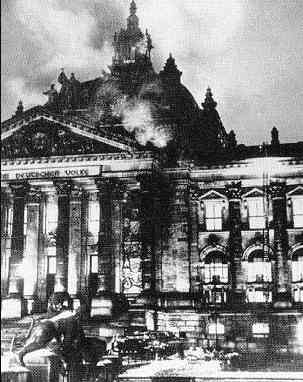
That takes away from its ideological cred, but here's my second reason: I think it's far more interesting and useful to look at the historical context and empirical evidence from Germany circa 1920s to explain fascism's rise. This relates to my general antipathy to political philosophy and the exaggerated role "ideas" supposedly play in politics. In other words, look at unemployment rates, the humiliation of the Versailles Treaty and the stabbed-in-the-back memes, or even the Reichstag fire, before you look at fascism's intellectual basis.

Anyone up for a fall reading of The Origins of Totalitarianism?

Friday, September 11, 2009

Re: Rising Health Care Costs

Actually, Michael Pollan's logic fits perfectly into the health-reform argument, at the same time as it endorses another pet liberal project (reforming food subsidies) -- no mean feat!

The logic goes something like this: if we spend as much as we do on health care as we do now -- one-sixth the economy, and all that -- we're not spending as much as we should on, say, fighting pollution or funding playgrounds for kids to play in and work off all that fat. David Goldhill made the point best in his much-cited Atlantic article:

From 2000 to 2008, the U.S. economy grew by $4.4 trillion; of that growth, roughly one out of every four dollars was spent on health care. Household expenditures on health care already exceed those on housing. And health care’s share is growing.

By what mechanism does society determine that an extra, say, $100 billion for health care will make us healthier than even $10 billion for cleaner air or water, or $25 billion for better nutrition, or $5 billion for parks, or $10 billion for recreation, or $50 billion in additional vacation time—or all of those alternatives combined?

The answer is, no mechanism at all. Health care simply keeps gobbling up national resources, seemingly without regard to other societal needs; it’s treated as an island that doesn’t touch or affect the rest of the economy.

Also, note Pollan's reference to "preventable chronic diseases." The current bills on the table would require all insurance companies to pay for routine check-ups and, yes, diabetes tests.

Rising Health Care Costs

The New York Times today features this op-ed written by Michael Pollan, in which he argues that most of rising health care costs in the US can be attributed to “preventable chronic diseases,” due to our choices in food consumption. Pollan, author of the best-seller “In Defense of Food,” says that if the country is truly serious about curbing health care costs and providing universal coverage, Congress and the president must go head-to-head with the food industry.

No small order, he says, as it’s led by that behemoth – and politically well-connected – interest group, agribusiness. Here’s a sample:
According to the Centers for Disease Control and Prevention, three-quarters of health care spending now goes to treat “preventable chronic diseases.” Not all of these diseases are linked to diet — there’s smoking, for instance — but many, if not most, of them are.

We’re spending $147 billion to treat obesity, $116 billion to treat diabetes, and hundreds of billions more to treat cardiovascular disease and the many types of cancer that have been linked to the so-called Western diet. One recent study estimated that 30 percent of the increase in health care spending over the past 20 years could be attributed to the soaring rate of obesity, a condition that now accounts for nearly a tenth of all spending on health care.The American way of eating has become the elephant in the room in the debate over health care.

Purposefully or not, his argument seems to mirror what many opponents of the Obama health care plan are saying: differences in health care cost across countries may have more to do with personal choices than with the lack of a national health care system.

Thursday, September 10, 2009

How Did Economists Get It So Wrong?

Two eminent economists offer their respective takes on why many economists missed the signs of the impending financial crisis.

First, Nobel-laureate Paul Krugman gives his take. In the September 6th edition of the New York Times Magazine, he argues that much of the blame should be directed toward the theories underlying modern finance, particularly the efficient-market hypothesis:
To be fair, finance theorists didn’t accept the efficient-market hypothesis merely because it was elegant, convenient and lucrative. They also produced a great deal of statistical evidence, which at first seemed strongly supportive. But this evidence was of an oddly limited form. Finance economists rarely asked the seemingly obvious (though not easily answered) question of whether asset prices made sense given real-world fundamentals like earnings. Instead, they asked only whether asset prices made sense given other asset prices. Larry Summers, now the top economic adviser in the Obama administration, once mocked finance professors with a parable about “ketchup economists” who “have shown that two-quart bottles of ketchup invariably sell for exactly twice as much as one-quart bottles of ketchup,” and conclude from this that the ketchup market is perfectly efficient.

Next, over at the National Interest, Barry Eichengreen gives us his view on why many got it wrong (linked to by Greg Mankiw). Eichengreen doesn’t think modern finance theory is to blame, however. He says theory is agnostic; those practicing a “selective reading” of certain financial risk management techniques are really to blame:
[I]t was not that economic theory had nothing to say about the kinds of structural weaknesses and conflicts of interest that paved the way to our current catastrophe. In fact, large swaths of modern economic theory focus squarely on the kind of generic problems that created our current mess. The problem was not an inability to imagine that conflicts of interest, self-dealing and herd behavior could arise, but a peculiar failure to apply those insights to the real world.

Interestingly, while the diagnoses are different, they both come to similar conclusions: less adherence to "elegant" and "neat" financial and economic theories and more realism.

Krugman:
So here’s what I think economists have to do. First, they have to face up to the inconvenient reality that financial markets fall far short of perfection, that they are subject to extraordinary delusions and the madness of crowds. ... [T]hey’ll have to do their best to incorporate the realities of finance into macroeconomics.

Eichengreen:
[T]he twenty-first century will be the age of inductive economics, when empiricists hold sway and advice is grounded in concrete observation of markets and their inhabitants. Work in economics, including the abstract model building in which theorists engage, will be guided more powerfully by this real-world observation. It is about time.

Indeed.

In the interests of fairness...

I offer this Corner post by John Derbyshire on the criticism of Friedman. I'm sympathetic to this sentiment.

Gummed Up [John Derbyshire]

Guys: Tom Friedman is certainly making an idiot of himself over China, but the following should at least be noted.Without at all excusing Friedman, one part of the motivation for remarks like his is the frustration many thoughtful Americans — by no means only China gulls — feel at our inability to get much of anything done. This comes up in lots of commentary by sensible conservatives, e.g. on the long stalemate over the rebuilding at Ground Zero.

A lot of us, including a lot of conservatives (remarks by Mark Steyn and George Will come to mind) feel that we have become so bureaucratized, lawyered-up, regulated, and PC-whipped that great national projects of the past — the trans-continental railroad, the transformation of Manhattan, the interstate highway system, wars we can actually win in less than a decade, . . . — are no longer possible. Our system has seized up somehow, and no innovation much bigger than a hand-held gadget stands a chance.

To us, stuck in this glue-trap, the sheer ability to get things done is bound to have some appeal, even when the agent of it is a brutish and callous despotism like China's. I don't say that explains (let alone excuses) all of Tom Friedman's foolishness, but it explains some of it.

*UPDATE: Jonah Goldberg's reply is also worth reading to place this in context.

Thomas Friedman's China man-crush....

Apropros our conversation yesterday about whether Thomas Friedman has fascistic tendencies given his extolling the virtues of the autocratic ability to "get stuff done" (which presumably is kind of like "making the trains run on time" in 1920's Italy)...

I saw this little nugget from NRO's Jay Nordlinger which would seem to dispel the idea that Friedman's comment was a passing one and not a core belief of his. Apparently in James Mann's 2007 work The China Fantasy: How Our Leaders Explain Away Chinese Repression, Mann quotes Friedman as saying the following in a column from several years ago:

For instance, Shanghai’s deputy mayor told me that as his city became more polluted, the government simply moved thousands of small manufacturers out of Shanghai to clean up the air. . . . At this time, when democracies, like India and America, seem incapable of making hard decisions, I cannot help but feel a tinge of jealousy at China’s ability to be serious about its problems and actually do things that are tough and require taking things away from people.

The autocratic ideal is apparently something that Friedman has been a fan for a while.

FPOD (First Post of the Day...or Ever!)

In honor of the first post on Hi-Res Publica, I want to post this video as a visual representation of what I hope this blog will become.

Enjoy it in all its glory.