In this telling, there’s something insidious about asking if they don’t do something better someplace else. But of course another way of looking at it is that you by definition can’t find examples of alternatives to the US status quo by looking at the US. That’s why you regularly see the Cato Institute touting Chile’s pension system or Heritage extolling the virtues of Sweden’s K-12 education or David Frum talking up French nuclear power. After all, we’ve never attempted to shift from a guaranteed pay-as-you-go pension system to a mandatory savings one in the United States. Nor do we have any examples of widespread operation of public elementary schools by for-profit firms. Nor do we have a robust nuclear power sector. So if you want to explore these ideas—ideas that conservatives often do want to explore—you need to look at models from abroad.
Friday, February 26, 2010
One More Lowry/Ponnuru Hit
Sorry for just linking, but I liked Matt Yglesias' reaction to aforementioned National Review article. The pair wrote that liberals constantly try to 'graft' European ideas onto America -- "Why couldn’t we be more like them — like the French, like the Swedes, like the Danes? Like any people with a larger and busier government overawing the private sector and civil society?" -- but Yglesias notes conservatives look for policy ideas from elsewhere as well (as any reasonable person should):

A Critique Of Conservative American Exceptionalism
Over at The New Republic, Damon Linker has a wonderful critique of Lowry/Ponnuru's article on how President Obama fails to defend 'American exceptionalism,' which they predictably define as synonymous with movement conservatism:
Lowry and Ponnuru are right about one thing: liberal love for the United States is complicated by criticism. And that appears to be something the right simply cannot abide, or perhaps even understand. How else to explain the bizarre passage of their essay in which Lowry and Ponnuru slam President Obama for failing to “defend the country’s honor” when a foreign critic “brought up the Bay of Pigs” during an overseas trip? Apparently “acknowledging that America has been a force for good” in the world, as Obama did, is not enough. The man who leads the nation that is by almost any measure indisputably the most powerful on earth must go further—to make a fool of himself and the country by defending an escapade from half-a-century ago that nearly everyone acknowledges was an embarrassing blunder. But that’s not all. According to Lowry and Ponnuru, he must also robustly defend American exceptionalism—and thus American moral superiority—before foreign audiences, evidently because it’s the president’s duty to provoke anger and resentment, and thus opposition to our global leadership, around the world.
Wednesday, February 24, 2010
The Tea Party Is Reading The Constitution
The New York Times had a long piece a week or two ago about the rise of the Tea Party phenomenon. A good read, which generated a lot of response from the Internet (apparently, the reporter spent six months criss-crossing America for the story).
Two interesting highlights: first, the piece makes clear how the massive economic downturn has contributed to the party's rolls. I find that noteworthy because, despite the never-ending recession trend stories and economic reports in the press, I still don't get the sense we appreciate the severity of this recession and the enormously difficult time so many Americans are enduring right now. We look at 10% unemployment, sure, but don't include the millions more who have given up looking for work or are under-employed. The Times also recently reported that as many as 1 in 8 Americans might be on food stamps. So, we have a bad economy, and I'd like to see what effect that has in our politics beyond asinine debates about tax credits and $15 billion jobs bills.
And second: the Times story notes that much of the Tea Party movement feeds on history and research seminars, including long discussions on the Constitution and the Federalist Papers. I'm puzzled the latter might prove inspiring for Tea Party types (unless used to interpret the founding document), since I'd take them to be more the anti-Federalist type. (Thoughts?)
But I'm also dismayed many people think the Constitution will solve any of our interpretive debates. It really won't; I'm always annoyed when people think, say, the Second Amendment is crystal clear (apologies to, um, everyone in this little forum who think that's the case). It's not clear to me, and even now, after the DC v. Heller case, lawyers and scholars puzzle as to whether the Supreme Court will incorporate it to apply to the states (which would just about blow my mind, since many Tea Partyers want to resurrect the states' rights mantra).
Don't get me wrong: it's good people are reading the Constitution; former Justice Sandra Day O'Connor has made a big deal lately about how civics education is badly needed in the country. Just don't think that the Text alone will definitively resolve any debates.
Two interesting highlights: first, the piece makes clear how the massive economic downturn has contributed to the party's rolls. I find that noteworthy because, despite the never-ending recession trend stories and economic reports in the press, I still don't get the sense we appreciate the severity of this recession and the enormously difficult time so many Americans are enduring right now. We look at 10% unemployment, sure, but don't include the millions more who have given up looking for work or are under-employed. The Times also recently reported that as many as 1 in 8 Americans might be on food stamps. So, we have a bad economy, and I'd like to see what effect that has in our politics beyond asinine debates about tax credits and $15 billion jobs bills.
And second: the Times story notes that much of the Tea Party movement feeds on history and research seminars, including long discussions on the Constitution and the Federalist Papers. I'm puzzled the latter might prove inspiring for Tea Party types (unless used to interpret the founding document), since I'd take them to be more the anti-Federalist type. (Thoughts?)
But I'm also dismayed many people think the Constitution will solve any of our interpretive debates. It really won't; I'm always annoyed when people think, say, the Second Amendment is crystal clear (apologies to, um, everyone in this little forum who think that's the case). It's not clear to me, and even now, after the DC v. Heller case, lawyers and scholars puzzle as to whether the Supreme Court will incorporate it to apply to the states (which would just about blow my mind, since many Tea Partyers want to resurrect the states' rights mantra).
Don't get me wrong: it's good people are reading the Constitution; former Justice Sandra Day O'Connor has made a big deal lately about how civics education is badly needed in the country. Just don't think that the Text alone will definitively resolve any debates.
Saturday, February 20, 2010
How Can Cities Reduce Crime?
One answer: have a higher Hispanic population. From the American Conservative, via Marginal Revolution:
The connection between Latino immigration and criminal behavior is much overstated....if we restrict our analysis to major cities of half a million people or more and compare the average crime rates for the five most heavily Hispanic cities—Albuquerque, Dallas, Los Angeles, San Antonio, and El Paso—to the those of the five whitest—Oklahoma City, Columbus, Indianapolis, Seattle, and Portland. This time, the more Hispanic cities are the ones with the lower crime rates—10 percent below the white cities in homicide and 15 percent lower in violent crime. A particularly remarkable result is that gigantic Los Angeles—50 percent Hispanic and frequently perceived as a dangerous urban hellhole—has violent crime rates close to those of Portland, Oregon, the whitest major city in the nation at 74 percent.
Monday, February 15, 2010
An "America in Asia"
I haven't finished reading this yet, but it's really interesting. This whole bit of history is new to me, so I can't really comment on how accurate it is. But the claim is that the Helmend Province area in which the Allied forces are currently engaged in a large battle is not, as you might expect, an ancient terrain or wasteland.
It's actually the intersection of an extremely wealthy fashion-center and remnants of a massive development effort to create an "America in Asia" back in the late 1940s, complete with the heavily planned city of Lashkar Gah. Really fascinating stuff.
It's actually the intersection of an extremely wealthy fashion-center and remnants of a massive development effort to create an "America in Asia" back in the late 1940s, complete with the heavily planned city of Lashkar Gah. Really fascinating stuff.
Saturday, February 13, 2010
The end of US Manned-Space capabilities...
I find the decision to defund NASA's manned space program really disheartening. I think it stems from all of the Star Trek that I watched growing up and the belief that our greatness is in part tied to our desire to understand that which is beyond us. We're not merely ants miring in the the empty dirt of our paltry little world. We strive to expand the limits of humanity. And there is nothing more "beyond us" than the adventure and scientific endeavors of space exploration.
Charles Krauthammer wrote a column about it here, outlining the ramifications of the decision. The U.S. will effectively be without the capability to put men in even low-earth orbit for the first time since John Glenn expanded our horizons.
The Administration felt that $3 billion dollars a year was just too much to take, which seems especially outrageous given how the government has been handing out stacks of billions of dollars like it's candy on Halloween. Fiscal discipline is sorely needed; but I find it asinine to argue that our space capabilities should be the first thing to go.
Charles Krauthammer wrote a column about it here, outlining the ramifications of the decision. The U.S. will effectively be without the capability to put men in even low-earth orbit for the first time since John Glenn expanded our horizons.
The Administration felt that $3 billion dollars a year was just too much to take, which seems especially outrageous given how the government has been handing out stacks of billions of dollars like it's candy on Halloween. Fiscal discipline is sorely needed; but I find it asinine to argue that our space capabilities should be the first thing to go.
Friday, February 12, 2010
Clinton in retrospect...
This is from NRO's "morning jolt" email that I receive. It generally annoys me when partisans come to find the merits of their old-time foes as some sort of argument against their current foe (for example how liberals love leading conservatives once they're dead; e.x. Reagan, WFB, etc.. And I'm sure there are examples going the other way.).
And there is a little bit of that in the message, but I also think there is some genuine appreciation involved. Anyway, thought it was worth posting:
[edited for typos: 12:56PST - EIS]
And there is a little bit of that in the message, but I also think there is some genuine appreciation involved. Anyway, thought it was worth posting:
1. Get Better, Bill
Bill Clinton's hospitalization seems like a good moment to reflect on how he looks a little better as a president ten years later, with the contrast of the Obama administration. My opposition to Clinton goes back to when FreeRepublic.com was getting breathless updates from the anonymous and mysterious "Quidam" -- updates which I think didn't pan out -- and most of his misdeeds from that era still look pretty ugly.
But with time, we begin to appreciate things we didn't realize at the moment, and what sticks out now is that Bill Clinton in many ways really was a "Bubba" -- he loved engaging with Americans of all types, something we haven't seen in many leading Democrats since then. He had his arrogant moments, but it's hard to imagine him explaining to a crowd of San Francisco liberals why small-town Americans are bitter and cling to guns and religion. Obama is adored by the elites and obviously can campaign in the worst neighborhoods of the most troubled cities, but he sticks out like a space alien in diners and truck stops. He (and to a certain extent Al Gore and John Kerry) can relate to deep-fried-Twinkie Americans only as their secular savior. And even if Bill Clinton's "y'all gotta hear about my Astroturf in my pickup truck" routine was an act, Clinton still felt like he owed whoever was in front of him his best back-slapping, extroverted charisma. (For a long time, it seemed like Hillary didn't have this quality, until she started throwing down shots and beers in the Pennsylvania primary.)
There's a lot of road still left to travel in Obama's presidency, but in many ways it seems to be echoing Clinton's early years -- a health-care reform effort that turns into a quagmire, scandals involving cabinet appointees, erupting fissures among congressional Democrats, a reunited and rejuvenated opposition, and a general overestimation of an electoral mandate. The 1994 Republican Revolution slapped Clinton hard in the face, and he recovered by veering to the center (including his signature achievement, a fairly conservative version of welfare reform). Obama seems to be offering us a fascinating alternative scenario: 2010 might be similar to 1994, but this Democratic president might not veer to the center. It's not his style, and it's not what he thinks he was elected to do..."
[edited for typos: 12:56PST - EIS]
Thursday, February 11, 2010
Live Blogging Iran
I thought this was worth passing along. It's makes for a sort of gripping reading as you go down through the day.
Here's to hoping that one day very soon the gangster regime in Tehran collapses under the weight of its own brutality.
Here's to hoping that one day very soon the gangster regime in Tehran collapses under the weight of its own brutality.
Tuesday, February 9, 2010
A Bigger Problem?
Paul Krugman suggests that the Greek portion of the Eurozone's debt problem may be overblown. For a bit of perspective, he presents us with this graph showing the proportion of Greece's GDP relative to Eurozone GDP:

Not a big problem, right? Unfortunately, Krugman's chart ignores the power (and weakness) of leverage. That's where we should start. If you want to compare Greece to the Eurozone – or anywhere else, for that matter – look at the size and composition of its debt. But more on that in a minute.
More importantly, Krugman's data don't capture this bit of news: Greek finance authorities have significantly understated the magnitude of their deficits. That is, to get around European regulation limiting deficits, Greece, with the help of Goldman Sachs brokers, traded in swap contracts that actually makes its deficits much worse.
From Felix Salmon:
Well, in a world like ours, people, companies, and yes, countries, can borrow above and beyond their economic output. Think of it this way: AIG's Financial Products division – a tiny office in a giant company – insured more than $441 billion worth of clever derivatives (credit default swaps) before things took a turn for the worse. Did AIG have the almost half-trillion dollars on hand to payout on those derivatives? Not even close.
But here's the thing about AIG, which explains why the Greece deficit story is problematic: we have to understand that a giant insurance company didn't bring the U.S. financial system to its knees. A tiny office in a giant company did. Or to put it another way, AIG's Financial Products division had far too much leverage, which AIG couldn't sustain.
Greece, like that tiny office in AIG, is considerably levered up. And now we find out that the country has been misrepresenting the extent of that leverage! My perspective is a bit different; indeed, Europeans should be heading for the hills.
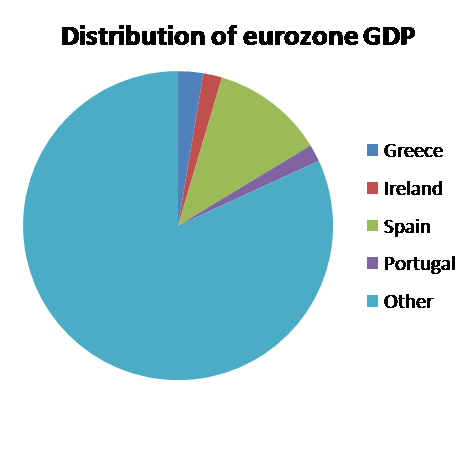
Not a big problem, right? Unfortunately, Krugman's chart ignores the power (and weakness) of leverage. That's where we should start. If you want to compare Greece to the Eurozone – or anywhere else, for that matter – look at the size and composition of its debt. But more on that in a minute.
More importantly, Krugman's data don't capture this bit of news: Greek finance authorities have significantly understated the magnitude of their deficits. That is, to get around European regulation limiting deficits, Greece, with the help of Goldman Sachs brokers, traded in swap contracts that actually makes its deficits much worse.
From Felix Salmon:
Greece has been hiding the true nature of its deficits and its debt using clever derivatives dreamed up by Goldman Sachs.Why is this important? Remember, Krugman's pie chart tells us that Greece's economic output is only a tiny fraction of the overall economic output of all of Europe. Things are bad for the Eurozone, he says, but not that bad.
[…]
It's a bit depressing that EU member states are behaving in this silly way, refusing to come clean on their real finances.
Well, in a world like ours, people, companies, and yes, countries, can borrow above and beyond their economic output. Think of it this way: AIG's Financial Products division – a tiny office in a giant company – insured more than $441 billion worth of clever derivatives (credit default swaps) before things took a turn for the worse. Did AIG have the almost half-trillion dollars on hand to payout on those derivatives? Not even close.
But here's the thing about AIG, which explains why the Greece deficit story is problematic: we have to understand that a giant insurance company didn't bring the U.S. financial system to its knees. A tiny office in a giant company did. Or to put it another way, AIG's Financial Products division had far too much leverage, which AIG couldn't sustain.
Greece, like that tiny office in AIG, is considerably levered up. And now we find out that the country has been misrepresenting the extent of that leverage! My perspective is a bit different; indeed, Europeans should be heading for the hills.
A Convenient Truth
President Obama from March of 2009:
This is the stuff of legends.
Over at AEI's The American, Andrew Biggs begs to differ:
To ensure that in this new Administration, we base our public policies on the soundest science; that we appoint scientific advisors based on their credentials and experience, not their politics or ideology; and that we are open and honest with the American people about the science behind our decisions. That is how we will harness the power of science to achieve our goals – to preserve our environment and protect our national security; to create the jobs of the future, and live longer, healthier lives.Finally, a U.S. president that refuses to pervert science and its processes to his own political ends. He says he's breaking with previous administrations who ignored the scientific consensus, who first made their conclusions and then generated the science to support them. This president says he'll listen to the science, no matter what, even when it's inconvenient to do so.
[…]
But let's be clear: promoting science isn't just about providing resources – it is also about protecting free and open inquiry. It is about letting scientists like those here today do their jobs, free from manipulation or coercion, and listening to what they tell us, even when it's inconvenient – especially when it's inconvenient. It is about ensuring that scientific data is never distorted or concealed to serve a political agenda – and that we make scientific decisions based on facts, not ideology.
This is the stuff of legends.
Over at AEI's The American, Andrew Biggs begs to differ:
The Obama administration's fiscal year 2011 budget continues a pattern of ignoring independent analysis and rigging economic assumptions to meet political goals. For the first time by any administration in memory, the Obama budget forecast rejects the Medicare Trustees' projections for long-run healthcare cost growth.Ignoring independent scientific analyses? Generating their own science? Well, isn't that just so convenient.
[…]
Ignoring independent analysis is a pattern for the Obama administration. During the healthcare debate, Medicare's actuaries produced an analysis showing that congressional health plans would increase rather than decrease national health expenditures. The White House rejected the actuaries' study and had the White House Council of Economic Advisors issue its own memo claiming that reform would "bend the cost curve." Likewise, bright minds within the Office of Management and Budget surely thought that if the Medicare Trustees' projections didn't suit their needs they would simply generate their own.
Monday, February 8, 2010
Authoritarian Creepiness
"When you hear the pluck of a harp on the radio, maybe Chavez is coming. It's suddenly, at any time, maybe midnight, maybe early morning."
Thus spoke Hugo Chavez. The preceding line is Chavez' way of advertising a new radio program starring – who else? – Hugo Chavez. According to the Venzuelan strongman, the new show could air at any moment. In addition to his television program, Aló, Presidente, Venezuelans can now look forward to over 5 hours a week of Chavez' musings on "21st century socialism."
How is that working out, anyway?
Thus spoke Hugo Chavez. The preceding line is Chavez' way of advertising a new radio program starring – who else? – Hugo Chavez. According to the Venzuelan strongman, the new show could air at any moment. In addition to his television program, Aló, Presidente, Venezuelans can now look forward to over 5 hours a week of Chavez' musings on "21st century socialism."
How is that working out, anyway?
Sunday, February 7, 2010
Pragmatism and Ideology
I wanted to spin another thread here to respond to Esquire's good comments on my comment (oy, this is getting confusing). Yes, I agree; most people already have firm ideological worldviews, which is why I dread the use of the label 'independents,' who clearly have political opinions and leanings.
But, as it happens, William Galston and Harvey Mansfield are having our very same discussion. Mansfield does a good job explaining your view, Esquire -- the issue of first principles, and how President Obama appears to try to "end" politics when he claims a consensus that does not exist (and instead only masks an ideological agenda). For Mansfield, and other conservatives, I imagine, the big question isn't, Will health reform insure 30 million Americans and improve the general welfare? It's, will the health reform bill unnecessarily expand government power, beyond its limited, original and rightful (in the moral sense) scope?
Galston's reply meanders a bit, but he makes some good points. An excerpt:
As I understand the president’s argument, it goes something like this: Our current health care system’s costs are rising at an unsustainable rate, threatening businesses, households, and our public finances. At the same time, nearly 50 million people go without health insurance—some by choice, to be sure, but most out of necessity. The only way to deal with all these problems effectively is to get nearly everyone into the insurance system, with a mix of subsidies and mandates, while creating a more competitive market among insurance plans. He may be right about this, or he may be wrong. But the key point for my purposes is that he is putting forth his plan as the means to an ensemble of ends—universal insurance coverage in a system that reduces the rate of cost increases—that he takes to be both desirable and essential to the long-term common good.
He goes on to say: 1) Obama's plan does not represent an emasculation of liberty; 2) "Freedom," like 'liberty,' means little in the abstract until you begin to define it in concrete levels; 3) The modern world requires a politics that is at once technical -- and, yes, slightly managerial -- even as it contends with age-old moral questions.
My thoughts for the day...
1) I'm really tired of hearing about Sarah Palin. She seems like a nice enough person, is probably not as dumb as political opponents claim, and is probably someone I wouldn't ever vote for (barring her demonstrating clear expertise in pertinent areas, anyway). But why does every Sunday Morning News Show feel the need to talk ad nauseum about her, as if she is the only Republican (or Conservative more importantly) in the country?
2) The "scandals" surrounding Rahm Emmanuel are ridiculous. His use of "retard" was definitionally correct and non-offensive, but even if it wasn't why must every opposition party feel its their place to call for the resignations of their political enemies? I don't care if he uses offensive language (particularly such a mild and ubiquitous word as "retard"). He serves at the leisure of the President; not ours. Let him help the executive govern and let us judge him on those actions. Not on pseudo-issues designed to create political environments. (From a policy standpoint, Emmanuel also strikes me as a moderate in comparison to most of Obama's leftist support; I'm not sure what conservatives would gain by removing a comparitavely sane voice in the White House [even if I thought his line about not wasting a crisis to be disdainfully cynical.])
3)I really like Rep. Paul Ryan. It's refreshing to see someone in government who clearly takes the time to understand the ins and outs of policy, as opposed to seemingly working solely off what aides tell them (or worse, what political aides tell them). I haven't had the chance to go through that link totally, btw. I'm basing my impressions off of watching him in interviews and reading his detailed columns and other works.
I'd like to dump the Republican leadership and replace them with Paul Ryan and others like him. One senses he's not a fan of leadership either. In an excellent interview/opinion piece with Ross Douthat from the NY Times that you should read, Ryan suggests:
"At the same time, [Ryan] allowed that “the problem in the minority [is that] you sometimes revert into a posture where ‘I don’t have to do anything controversial, I just can be against that and win by default.’ I’m not interesting in winning by default. And I’m worried that if we get the majority back by default, we’ll screw up again.”
Me too. So far, they offer nothing to be excited about. But I am excited by the hope of Ryan will have great influence over the party in the future.
(Btw, regarding his webpage...I'm glad to see that a Republican finally found a web-designer who wasn't using Microsoft Frontpage at best).
2) The "scandals" surrounding Rahm Emmanuel are ridiculous. His use of "retard" was definitionally correct and non-offensive, but even if it wasn't why must every opposition party feel its their place to call for the resignations of their political enemies? I don't care if he uses offensive language (particularly such a mild and ubiquitous word as "retard"). He serves at the leisure of the President; not ours. Let him help the executive govern and let us judge him on those actions. Not on pseudo-issues designed to create political environments. (From a policy standpoint, Emmanuel also strikes me as a moderate in comparison to most of Obama's leftist support; I'm not sure what conservatives would gain by removing a comparitavely sane voice in the White House [even if I thought his line about not wasting a crisis to be disdainfully cynical.])
3)I really like Rep. Paul Ryan. It's refreshing to see someone in government who clearly takes the time to understand the ins and outs of policy, as opposed to seemingly working solely off what aides tell them (or worse, what political aides tell them). I haven't had the chance to go through that link totally, btw. I'm basing my impressions off of watching him in interviews and reading his detailed columns and other works.
I'd like to dump the Republican leadership and replace them with Paul Ryan and others like him. One senses he's not a fan of leadership either. In an excellent interview/opinion piece with Ross Douthat from the NY Times that you should read, Ryan suggests:
"At the same time, [Ryan] allowed that “the problem in the minority [is that] you sometimes revert into a posture where ‘I don’t have to do anything controversial, I just can be against that and win by default.’ I’m not interesting in winning by default. And I’m worried that if we get the majority back by default, we’ll screw up again.”
Me too. So far, they offer nothing to be excited about. But I am excited by the hope of Ryan will have great influence over the party in the future.
(Btw, regarding his webpage...I'm glad to see that a Republican finally found a web-designer who wasn't using Microsoft Frontpage at best).
This is sure to annoy some...
Looking at mainstream Liberal Condescension.
It does also touch indirectly on how ideology plays into policy (and how many Liberals view themselves as un-ideological).
(I'm not sure if a free login is required. I have all my cookies saved and so never have to input anything...)
It does also touch indirectly on how ideology plays into policy (and how many Liberals view themselves as un-ideological).
(I'm not sure if a free login is required. I have all my cookies saved and so never have to input anything...)
Friday, February 5, 2010
The Supreme Court and Race
This essay from Harvard law professor Michael Klarman got a lot of attention last week. An excerpt:
The conservative justices’ hostility to affirmative action reflects a constitutional double standard. These are the same justices who ordinarily—for example, in cases involving abortion, gay rights, or physician-assisted suicide—profess commitments to judicial restraint, democratic decision making, respect for states rights, and an interpretive methodology of textualism and originalism. Yet, all of these considerations point in the direction of permitting race-based affirmative action. To strike down affirmative action programs is for unelected judges to invalidate the policy preferences of state and local governments on a thin constitutional basis. The text of the Fourteenth Amendment says nothing about government color-blindness—indeed, Section One doesn’t even mention race—and the original understanding of those who adopted and ratified the amendment was plainly not a mandate of color-blindness. The Framers of the Fourteenth Amendment (and their constituents) were too racist to require government to eschew all racial classifications. They thought that laws disenfranchising blacks, excluding them from jury service, segregating them in schools, and forbidding interracial marriage would plainly be permitted under the new amendment.
The Proper Role Of Ideology
In our last exchange on fascism, Esquire commented that the Founding Fathers were on his side (of course) because they spent much time thinking about the "proper role of government (a philosophical idea)," thereby showing the importance of Big Ideas in politics.
Well, let's clear things up. Obviously, when it comes to the biggest idea of them all -- power by consent -- I'm with the ol' Fathers on this one. I may quibble about natural rights here and there, but I won't argue with their foundation. That is, I wouldn't support a dictatorship even if it were proven it could better promote its subjects' welfare (see my position in the India v. China debates, for example).
But that's the not the issue, really. Because the Founders also had to pay a lot of attention to the nitty-gritty specifics of setting up the government (more Montesquieu's separation of powers than Locke's Second Treatise). Read accounts of the Philadelphia convention, and you're struck by the amount of time paid to things like how votes should be counted, the setup of the Senate and so on. Once you get past the big, abstract idea, you have to deal with concrete policy proposals, and that's what I'm more interested in. (Not fascism versus representative democracy, which I think we all agree on.)
Now, of course, there's a proper role for pragmatism. I suspect Esquire dislikes pragmatism because its wishy-washiness does not enact enough strict safeguards against government abuse (which is why I believe he linked to Tom Friedman's ever-glowing reviews of the Chinese state). I get it. There are powerful moral foundations in favor of limited government. But pragmatists can still believe in democratic freedoms and not believe in, say, natural rights or first principles. (As Richard Rorty said, take care of freedom, and truth will take care of itself.)
And herein lies our debate: I think certain measures (raising the marginal tax rate by a few points, for instance, or providing for seniors' health care) don't augur the end of democracy. I believe that because I think the Founders left us with a very good system of checks and balances and institutional safeguards and the vote, and other concrete measures beside their powerful texts on representative democracy.
So where does Fascism fit in here? Esquire thinks I think it's a nothing-ideology, only synonymous with suffering and terror. That's not really fair, because people use the F-word precisely because of its historical power and meaning. (A duck is a duck is a duck, just as fascism is the Holocaust.)
But let's get past that, because Esquire earnestly thinks Fascism contains an articulate set of beliefs (or rather, Jonah Goldberg does, therefore Esquire does). We disagree about that, as well. Plain and simple, we disagree here. I think it's a hodge-podge, a weird mix of racial Darwinism, a belief in a God-like head of state, historical revisionism and scientific rationalism. Marxists can point to some seminal texts and ideas -- the fetishism of commodities, the surplus value, class consciousness, and so on -- but Fascists can't (other than, say, Jews aren't human). Try reading Mein Kampf -- it's not Das Kapital, by any means.
That's one disagreement. The other is that we have different ideas about why Fascism was so evil. It wasn't because it built the Autobahn or its head had some "progressive" ideas about vegetarianism and animal rights, but because it believed in the annihilation of an entire group of people as well as rule by dictatorship. Evil isn't a highway or national health insurance, it's the Holocaust (and an unchecked executive).
Third -- and finally -- we disagree because the Fascism did not rise to power merely on the merits of its "ideas." As I've said before, there were on-the-ground conditions that facilitated the rise of extremism and anti-democratic movements (high unemployment, hyperinflation, a weak government hobbled by the Weimar constitution, a volatile geopolitical environment). Those things are equally as important as anything Carl Schmitt thought about the law.
That -- along with other historical disagreements, like the continued denigration of the Social Democratic Party and the German Communist Party, which fought the Fascists with praise-worthy courage -- is why we stand apart. Not because I have anything against constitutional freedoms.
The Power of the Presidency
Jack Goldsmith's back, with another excellent essay in this month's New Republic. It's a review of John Yoo and Garry Wills' books on the constitutional extents of executive power, and it includes an interesting historical analysis that shows why liberals supported powerful presidencies until Vietnam, while conservatives adopted a mirror path. One excerpt:
A second lesson is that the text and the original understanding of the Constitution often do not yield determinate answers concerning the separation of powers. Yoo is right to emphasize that the Framers--burned by their experience with the feckless executive power that the Articles of Confederation had lodged in Congress--created a strong and independent presidency that could enforce the law, and help maintain the national defense, and act swiftly in crisis. This is a point downplayed by Burnham and modern presidential critics, just as Yoo downplays the ways the Constitution sought to place legal checks on the president. The complicated truth is that the Framers had cross-cutting concerns about legislative and executive power and spoke in many voices. They worried about a too-weak Congress and a too-strong Congress and about a too-weak president and a too-strong president. The Constitution’s final allocation of power involved many compromises embodied in sometimes imprecise provisions that meant different things to different people and interacted in unpredictable ways.
Thursday, February 4, 2010
You Know What?
James Kwak of Baseline Scenario shows us that the introductory economics textbooks have it wrong. Higher taxes may not distort work incentives: economic growth is just as robust when the top marginal income tax rate is say, 90%, than when it's at something like 30%.
Here's his graph plotting the top marginal tax rate against annual real GDP growth since 1947:

Of course, this is just a simple graph; it's not a dispositive argument for higher marginal tax rates. And it wrongly conflates annual real GDP growth with the productive incentives of workers. For instance, last week's GDP numbers tell us that the economy grew at a healthy clip last quarter – 5.7%. For some, this is a cause to celebrate. But with structurally high unemployment, limited access to credit, and waning consumer confidence, GDP growth has very little to say on whether tax payers should work more or less.
Yet Kwak's overall point remains. For those who argue that higher marginal tax rates are bad for the economy, I wonder if this graph will give them pause. At the same time, I also wonder how someone like Greg Mankiw would respond. He, of course, has argued forecefully that higher marginal taxes create perverse work incentives. From last October's NYT:
Here's his graph plotting the top marginal tax rate against annual real GDP growth since 1947:

Of course, this is just a simple graph; it's not a dispositive argument for higher marginal tax rates. And it wrongly conflates annual real GDP growth with the productive incentives of workers. For instance, last week's GDP numbers tell us that the economy grew at a healthy clip last quarter – 5.7%. For some, this is a cause to celebrate. But with structurally high unemployment, limited access to credit, and waning consumer confidence, GDP growth has very little to say on whether tax payers should work more or less.
Yet Kwak's overall point remains. For those who argue that higher marginal tax rates are bad for the economy, I wonder if this graph will give them pause. At the same time, I also wonder how someone like Greg Mankiw would respond. He, of course, has argued forecefully that higher marginal taxes create perverse work incentives. From last October's NYT:
The verdict on supply-side economics is mixed. The most striking claim associated with the theory — that cuts in marginal rates could generate so much extra work effort that tax revenue would rise — is unlikely to apply except in extreme cases. But substantial evidence supports the more modest proposition that high marginal tax rates discourage people from working to their full potential.You know what? It seems the verdict on marginal tax rates is just as mixed.
Wednesday, February 3, 2010
Not A Fan of Nudging
I was on my favorite sum total of all human knowledge search engine this morning looking for a passage in an article that I expressly remember reading. The problem is, I don't remember when I read the passage nor do I remember the author of the article or even where I found the passage. The only thing I do remember is that it's a good passage.
Anyway, in my futility, I came across this short interview with Tyler Cowen. This part is a gem:
Anyway, in my futility, I came across this short interview with Tyler Cowen. This part is a gem:
FE: Do you have a morning news and blog reading routine? Could you describe it for us?There you have it. If Tyler Cowen says nudging is oppressive, then I say nudging is oppressive!
Mr Cowen: I get up at 7 a.m. or so and I read The Washington Post, Wall Street Journal, New York Times, and Financial Times, with breakfast somewhere in the middle of those. Atonal music or Indian classical music are the preferred soundtracks, at least if my wife is leaving for work. I've just started using an RSS reader, although I don't like how it oppressively "nudges" me into reading everything in it [emphasis mine].
Tuesday, February 2, 2010
Sullivan's Statement
Andrew Sullivan's call to arms:
[A]lmost a decade after 9/11, here we have the real thing: a Muslim democratic movement that has grown from within and is led by the next generation, in which the symbols and tropes and color of Islam are being marshaled to defend human rights, and democratic processes, and the civil sacredness of un-rigged elections.
Bipartisanship Can Never Exist
James Fallows explains why it's impossible to have a bipartisan Congress.
Monday, February 1, 2010
"The Erosion of Women's Rights, Illustrated"
Thought this brief little example was interesting.
See here for a pictoral (there's a more in-depth link as well).
See here for a pictoral (there's a more in-depth link as well).
Subscribe to:
Comments (Atom)


